
In football, before an official match begins, the coach must always select the most suitable players to take the field. This lineup determines how the team operates tactically, its ability to control the game, as well as its attacking and defensive approach. So, What is a starting lineup? Why does choosing the 11 starting players have such a major impact on the outcome of a match? All of this will be clarified by 90 Phút TV below.
What Is a Starting Lineup?
What is a starting lineup? It is a group of 11 players selected by the coach to begin an official football match. These 11 players usually include one goalkeeper and 10 outfield players occupying different positions depending on the tactical formation.
The starting lineup is announced before the match and can be changed based on fitness, form, injuries, or tactical considerations. Players who are not included in the starting lineup will sit on the substitutes’ bench and may be brought onto the pitch during the match.
Determining the starting lineup is one of the most important preparation steps before every match. The coach needs to consider the balance between the lines, the coordination between individual players, and how to deal with the opponent.

The starting lineup consists of 11 players selected to begin the match
What Positions Are Included in a Starting Lineup?
Basically, a team has 11 players in its starting lineup. However, how the 10 outfield players are distributed depends entirely on the tactical formation chosen by the coach.
The goalkeeper protects the goal and is responsible for stopping the opponent’s shots. In front of the goalkeeper is usually the defensive line, consisting of center-backs and full-backs. The midfield is responsible for controlling possession, competing for the ball, and connecting defense with attack.
In attack, a team can use one or more forwards. Some formations feature a lone striker, while other systems use two forwards or combine forwards with wingers.
Fans following 90Phut TV can notice that even with the same team, the positioning of players can change significantly from one match to another.
Common Tactical Formations
Modern football has many tactical formations, but 4-3-3, 4-2-3-1, 4-4-2, and 3-5-2 remain among the most commonly used systems. Each formation creates a different distribution of space and responsibilities.
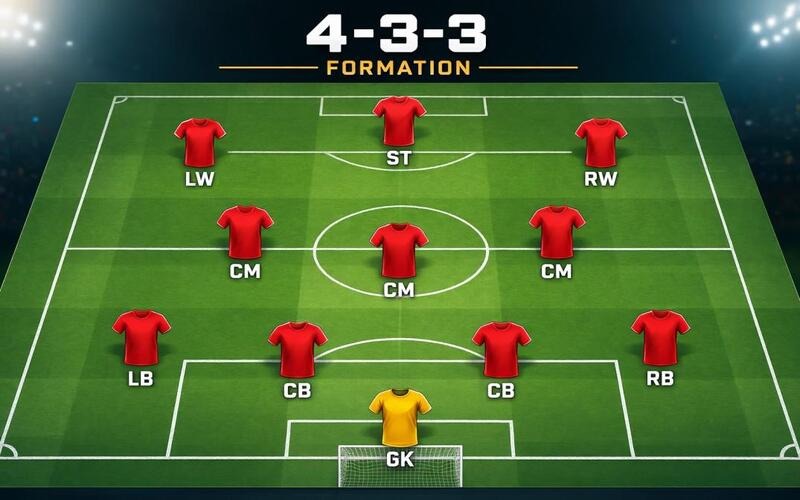
The 4-3-3 formation usually consists of four defenders, three midfielders, and three attacking players. This system allows the team to control the midfield while exploiting width through the wingers.
Meanwhile, 4-2-3-1 uses two central midfielders who tend to provide defensive support in front of the back line. Ahead of them is an attacking midfielder operating directly behind the striker.
When watchingtructiepbongda hom nay, fans can clearly observe how the formation on paper is transformed into actual positions on the pitch. During the match, players move constantly, so the initial formation can change depending on the situation.

The 4-3-3 and 4-2-3-1 formations are common tactical systems
Why Is Choosing the Starting Lineup Important?
The starting lineup directly affects how a team begins a match. A coach may choose an attacking lineup when they want to apply pressure from the start or use more defensive players when prioritizing solidity.
The ability of players to coordinate with one another is also an important factor. A lineup filled with stars but lacking chemistry may not necessarily operate as effectively as a team whose players understand each other’s roles well.
In addition, player selection depends on the opponent. If facing a team that is strong on the wings, the coach may use fast defenders. If the opponent plays with a low defensive block, players who are capable of passing and operating in tight spaces may be preferred.
Through the lịch bóng đá updated by 90P TV, fans can proactively follow important matches and wait for lineup information before kickoff.
When Is the Starting Lineup Announced?
Normally, the official lineups of both teams are announced a certain amount of time before the match begins. The announcement time may vary depending on the competition and the organizers.
Lineup information usually includes the 11 starting players along with the substitutes. Some platforms also display the expected tactical formation so viewers can more easily visualize the position of each player.
Waiting for the official lineup also generates particular interest before major matches. Fans want to know which stars will start, which players will be on the bench, and whether the coach will make any tactical surprises.
On 90 Phút TV, pre-match information such as lineups, form, and notable factors gives viewers additional data before watching the match.

The official lineup is usually announced before the match
The Starting Lineup Can Change During the Match
The initial lineup is not a fixed structure throughout the full 90 minutes. As the match progresses, the coach can adjust player positions to adapt to developments on the pitch.
For example, a team that is leading may switch to a more defensively solid system. Conversely, if trailing, the coach may bring on another forward and change the structure of the lineup.
Injuries can also force changes to the lineup. A starting player may have to leave the pitch and be replaced by another player. In addition, disciplinary cards or fitness levels can affect how the team operates.
These changes are often clearly visible when watching 90m TV, especially in decisive matches.
Factors Affecting Lineup Selection
The coach must consider many factors before deciding on the starting lineup. A player’s recent form is one of the most important criteria. Someone who is currently in good form is generally more likely to be selected to start.
Fitness also plays an important role. If a player has just competed at high intensity in the previous match, the coaching staff may allow them to rest to reduce the risk of injury.
The nature of the match also affects the decision. A group-stage match may be approached differently from a final or a decisive title-clashing encounter.
When watching tructiepbongda hom nay, viewers can compare the announced lineup with the players’ form and the actual tactics to better understand the coach’s decision.
Starting Lineup and Tactical Approach
What is a starting lineup? It cannot simply be understood as a list of 11 starting players. In reality, it is also the foundation for implementing a team’s entire tactical idea.
If using a 3-5-2 formation, the coach needs center-backs who are good at defending space, along with wing-backs who have enough stamina to move up and down continuously. With a 4-3-3, the roles of central midfielders and wingers become particularly important.
A team can change its formation during a match without making a substitution. Players only need to change their positions and responsibilities according to instructions from the coaching staff.
This is why people who regularly follow lịch bóng đá are not only interested in kickoff times but also pay attention to the lineups and tactical formations of both teams.

The coach uses a tactical formation to assign responsibilities and positions to each player in the starting lineup
Distinguishing the Starting Lineup from the Substitutes
The starting lineup consists of players who begin the match, while the substitutes are players who do not start but may be used during the match.
Substitute players play a very important role. They can make a difference when a team needs to change tactics, increase attacking strength, or reinforce the defense.
In a match lasting 90 minutes, using substitutions effectively can directly affect the result. A substitute with good pace can cause problems for the opposition defense when the defenders are already fatigued.
These developments are often updated quickly on 90P TV, helping viewers keep track of personnel changes during the match.
The Role of the Lineup in Modern Football
Modern football emphasizes flexibility and the ability to transition between different states. Therefore, the starting lineup is only the starting point for a complex tactical system.
A player may begin in a wide midfield position but frequently move into central areas. A full-back may push forward like a winger, while a defensive midfielder may drop between the two center-backs to help build play.
These changes make lineup analysis more interesting. Fans are not only interested in who starts but also want to know how that player will be used.
When following tructiepbongda hom nay, observing how each player’s position changes will help viewers better understand the tactics applied by the coaching staff.

The theoretical formation can change continuously during the match depending on the team’s attacking state
Conclusion
What is a starting lineup? It consists of 11 players selected to begin a match, but its significance is much greater than a simple personnel list. The starting lineup reflects the players’ form, the team’s available personnel, and the coach’s tactical ideas.
For fans, following the lineup before the match together with lịch bóng đá is an effective way to gain an overall view of the encounter. At the same time, platforms such as 90Phut help viewers access football information and follow matches that attract attention.